Curtiss Annotation Nomenclature
Official Reference Documentation for The Curtiss Annotation Nomenclature (C.A.N.) System
Quick Reference
C.A.N. Codes
- ! – Surprising or unexpected
- ? – Question validity or accuracy (doubt correctness, not comprehension)
- A – Noteworthy (i.e. good, bad, peculiar etc.) analogy
- AG – Agree with this (can also use with a note for a disclaimer-added agreement)
- AL – Allegory - entire story has symbolic deeper meaning
- AO – Abolition - abolitionist thinking regarding oppressive systems
- AP – Application - how to apply concept in practice
- AR – Argument structure or logical progression - how argument is built
- AS – Assumption - stated or unstated, foundational or questionable
- AT – Action/Task – something to do or implement
- AU – Allusion - indirect reference to other works or events
- B – Breakthrough - author’s major insight or discovery
- BG – Background context - historical, cultural, technical, geographical
- BV – Behavior – behavioral patterns, behavioral economics, habits, actions
- C – Claim or argument being made
- CA – Counterargument - addresses opposing views
- CB – Callback - references earlier moment in text
- CE – Cause and effect relationship
- CF – Confusing or unclear (comprehension issue, not doubt)
- CH – Character insight or development, or noteworthy/important character
- CN – Conclusion - main takeaway or conclusion
- CO – Connect to another book, current events, or personal experience
- CR – Cross-reference - author explicitly cites another passage, book, or verse
- CT – Critique - author critiques another idea, philosopher, or theory
- CX – Context crucial - requires cultural or historical background to understand
- D – Definition - term explicitly defined
- DI – Dialogue - particularly noteworthy character speech
- DK – Dark, distressing - depressing, sad, bleak, traumatic, grief
- DL – Dialectic - dialectical method, Socratic questioning, thesis-antithesis-synthesis
- DO – Doctrine - doctrinal position (includes ecclesiology, eschatology)
- DT – Date or timeline marker - important chronological information
- E – Evidence or data - supports argument (includes statistics, qualitative evidence etc.)
- ER – Erasure or silence - historical erasure, archival silence, what’s missing
- ET – Ethical teaching - moral instruction
- EX – Example or illustration - clarifying example (pedagogical purpose)
- FH – Foreshadowing - hints at future events
- FL – Flaw in reasoning - logical fallacy, methodology error, code bug
- FN – Footnote or note - important footnote, endnote, or marginal note
- FO – Formula or equation - important to know (financial, scientific, mathematical)
- FR – Framing argument - sets up later argument
- H – Humorous or funny
- HF – Historical fact - factual event or date
- HG – Hegemony – dominant ideology or power structure (White Supremacy etc.)
- HY – Hyperbole or exaggeration
- I – Ironic – noteworthy irony
- IN – Insight - your personal realization (not author’s discovery)
- IS – Institution or structure - institutional racism, structures
- IX – Intersectionality - race, gender, class, sexuality intersection
- J – Beautiful, lovely, and/or moving in a significantly pleasant capacity
- JX – Juxtaposition or contrast - comparing opposites
- JY – Joy or pleasure - joy, pleasure, life-making
- KC – Key concept - central important concept
- LG – Law or legal - legal structures, legislation, case law, treaties
- LN – Language – Any language-related note (i.e. French, English, German, Latin etc.)
- M – Metaphor – noteworthy direct comparison
- MI – Massive implications - far-reaching consequences or importance
- MO – Model or framework - theoretical model, diagram, organizational framework
- NL – Neologism - invented term, or (technical, intentional or unintentional) redefinition
- NT – Counter-narrative - challenges dominant narrative
- OP – Oppression – theorization of oppression (anti-Blackness, sexism, ableism etc.)
- PA – Pattern - recurring theme, design pattern, or motif
- PF – Proof or derivation - mathematical or logical proof step
- PP – Perspective or point of view - whose narrative or viewpoint
- PR – Principle - foundational rule or teaching
- PX – Paradox or mystery - contradictory statement revealing truth
- Q – Quote worthy - would use this phrase (or some variation) in your own writing
- R – Research, review, or link - return to this for any reason
- RA – Resistance or agency - acts of resistance, refusal, fugitivity, escape
- RG – Rage or anger - righteous anger, political anger
- RH – Rhetorical device - effective persuasion technique
- RK – Risk – risk analysis, risk management (finance, business, psychology, medicine)
- RV – Recovery - historical recovery or reclamation
- S – Setting or environment building - physical or atmospheric
- SB – Sidebar or box - key information in sidebar, callout, or boxed text
- SC – School of thought - philosophical tradition, political ideology
- SO – Source code example - particularly noteworthy implementation
- SP – Speculation or imagination - what-if, critical fabulation, radical imagination
- SS – Sound or style technique - alliteration, rhythm, sentence structure
- ST – Story – retell-able narrative (includes personal anecdotes, parables, case studies)
- SU – Summary or synthesis - author compresses complex idea
- SY – Symbolic or figurative - non-literal interpretation
- T – Thematic statement - central theme or thematic claim
- TC – Technology or concept - interesting tech or scientific idea
- TE – Technical explanation - algorithm, architecture, process, philosophical system
- TH – Thought experiment - philosophical hypothetical or gedankenexperiment
- TM – Terminology - specific technical term used
- TP – Turning point or pivotal moment
- TS – Test or study material - likely exam material, must know
- TV – Text variant - different manuscript readings
- TX – Translation issue - English obscures original meaning
- V – Verse reference - important scripture citation
- VI – Vivid imagery - striking visual description
- VL – Violence - structural violence or state violence
- VZ – Visual - important diagram, chart, graph, table, or image
- W – Love the wording, diction, and/or phrasing
- WB – Worldbuilding - creating unique fictional universe rules
- WS – Word study - etymology, semantic range, nuance
- WT – Witnessing or testimony - first-person accounts with evidentiary weight
- WV – Worldview revealed - author’s fundamental beliefs showing through
- X – Disagree with this
C.A.N. Emphasizers
- + – Positive – “x” CAN Code is a supremely good thing, or a thing you really like
- - – Negative – “x” CAN Code is a supremely bad thing, or a thing you really dislike
- * – Critical/Important – “x” CAN Code is supremely important and really critical
Annotation Diagram
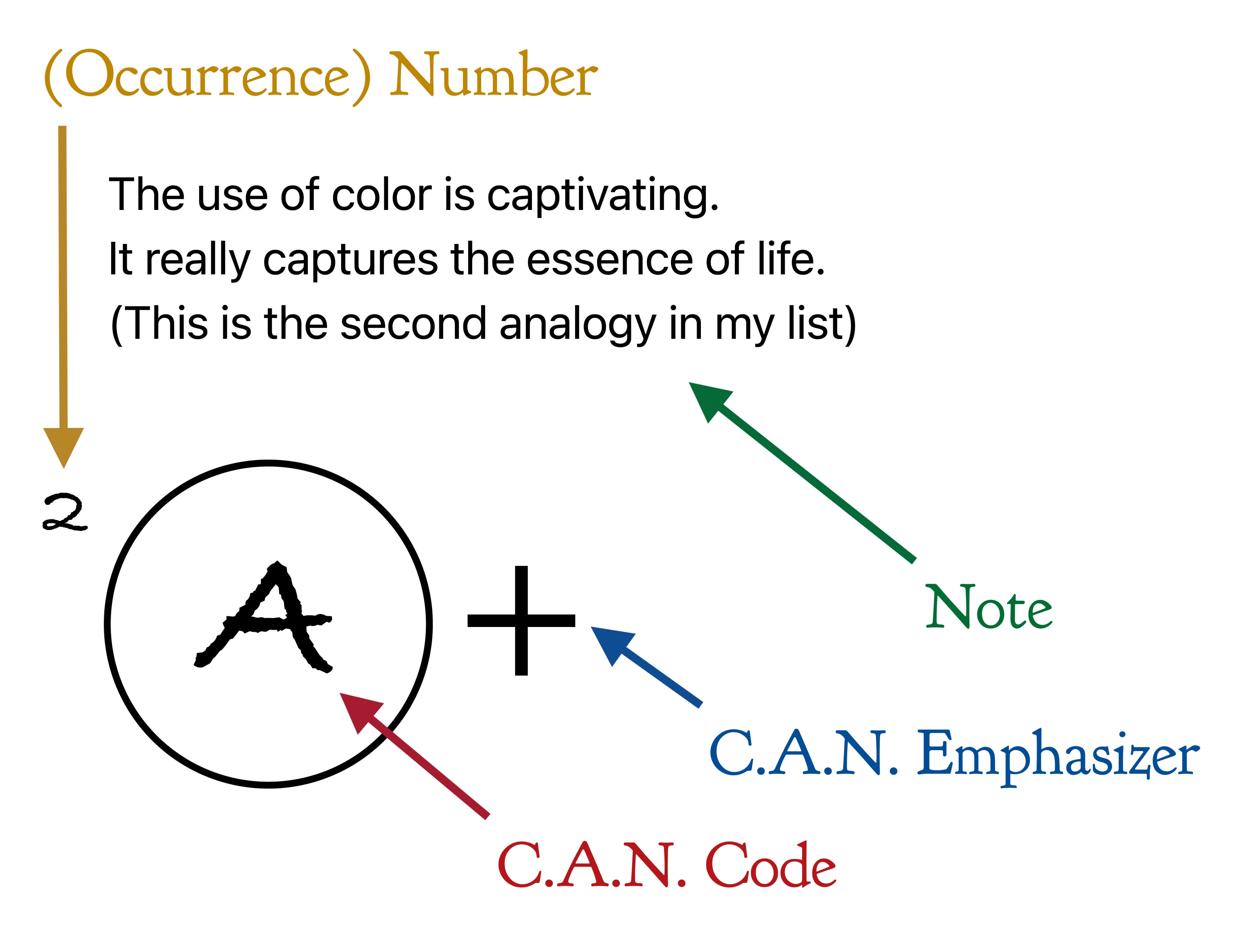
- Annotation - This is the entire object in the margin, all the items/objects that makes up your thought
- Note - Your explicit written content (not a CAN Code or CAN Emphasizer), in your own vocabulary
- CAN Code & CAN Emphasizer - These are defined above
- (Occurrence) Number - This is a number for counting/tracking some specific pattern
How to Annotate
In the margin:
- Write one CAN Code
- Circle the CAN Code
- [Optional] Add one CAN Emphasizer (+,-, or *) to the right, and outside the circle
- [Optional] Add a note (i.e. the explicit content of your annotation) outside the circle.
- The note can be placed above the cirlce, or below the circle, or to the right of the circle (but only if a CAN Emphasizer is not to the right)
- [Optional] Add a single number, outside the circle, to the top left, and below the arch (i.e. this allows support for notes to be place above the circle and maintain readability)
- It is strongly recommended that numbering only be used for counting the number of occurrences of annotations that contain the same CAN Code
Key Points & Recommendations
- CAN Codes are primarily intended to mark noteworthy passages, not necessarily good or bad passages. Use a CAN Emphasizer or a note to clarify your opinion.
- You must only ever use one CAN Code per annotation and in the margin
- This facilitates optimal interoperability among readers and leads to a shared annotation fidelity.
- And one CAN Emphasizer per annotation Place it outside circle so you can change it later if needed.
- Use CAN Emphasizers sparingly, they’re only for strong reactions (e.g. strong like, strong dislike, or critical importance).
- You should also use one annotation per passage
- You can have multiple annotations for one passage, but you must not have multiple CAN Codes for the same annotation
- This means you should choose the single CAN Code (and, when desired, CAN Emphasizer) that best captures your thoughts, and fulfills your needs. You should use the note in the annotation to elaborate